Let me tell you what “deep cleaning” used to mean to me.
It meant I had to do everything.
Not just wipe down the counter. Not just vacuum the floor. I’m talking baseboards, inside cabinets, behind the toilet, under the bed, light fixtures… all of it.
And if I couldn’t do all of it, it didn’t feel worth starting.
That all-or-nothing thinking will keep your house dirty for months.
Add ADHD to the mix and it gets worse. Decision fatigue combined with random bursts of motivation. Low-energy days. A packed schedule.
Suddenly it’s been six weeks and you’re still “planning” to deep clean without having actually done anything. Super annoying.
So I stopped trying to do it perfectly.
This deep cleaning checklist is not about cleaning your entire home in one weekend. I don’t even like the sound of that.
It’s about working at your own pace and matching the task to your actual energy level so you don’t burn out halfway through and avoid it for another three months.
You don’t have to finish everything. You don’t have to do it fast. You just have to start somewhere.
This post contains affiliate links to great products that will help you in your health journey. I will get a commission if you decide to buy from these links but I’m only recommending products that I feel confident about and from companies that I trust like Amazon and others. Please let me know if you have any questions.
Want to read this post later? Save it to one of your Pinterest boards!
How to Use This Deep Cleaning Checklist (Without Overcomplicating It)
Let’s clear something up right now.
You are not meant to do everything on this checklist in a few days. That will wear you out and make you resent cleaning altogether.
Instead, use it in short chunks. Skip around. Repeat sections. Stop halfway through and come back later. This is not a competition. No one is timing you.
Here’s the simplest way I use it:
- Pick one room or one category
- Choose tasks that match your current energy level
- Stop when your focus or energy drops
If setting a timer helps, aim for 15–20 minutes. If timers stress you out, ignore them. I can’t lie, I often forget I set a timer anyway, so I’m not fully convinced they’re magical. But if they work for you, use them.
Think of this checklist like a menu. You’re allowed to choose. You don’t have to “order everything.”
Start With Your Energy Level, Not the Room
Most deep cleaning lists assume you wake up with the same amount of energy every single day.
That’s not real life.
Some days I can wipe down the whole kitchen and feel fine. Some days taking out the trash feels like an accomplishment. Both are valid.
So instead of asking, “What room should I deep clean?” I ask, “How much energy do I actually have right now?”
As you go through this list:
- Start with the low-energy section if you’re already tired
- Move to medium-energy tasks if you have momentum
- Treat high-energy tasks as optional, not required
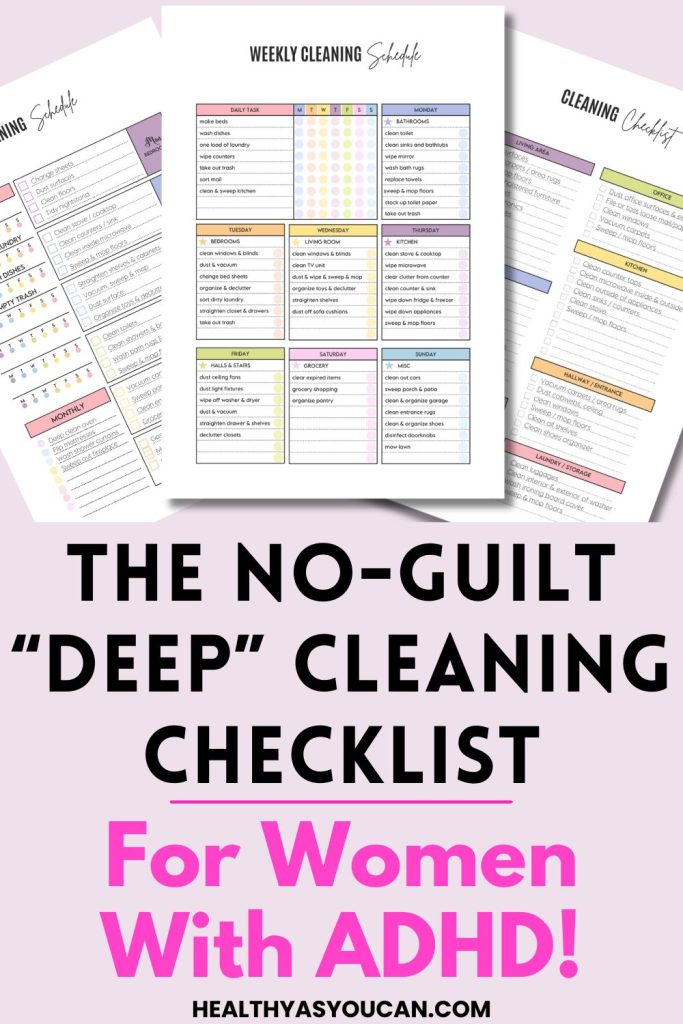
This one shift alone keeps me from spiraling. If it would help, I have an ADHD cleaning planner in my shop that you can take a look at here. It is chocked full of cleaning checklists for deep cleaning, regular cleaning, spring cleaning and more.
But what makes it different from other ADHD cleaning planner is that it doesn’t leave you hanging. It has a guides, tutorials, and encouragement throughout the planner.
I know i have stared blankly at many planners not knowing where to start or how to use it. But this planner gives guidance throughout so you aren’t left figuring out what to do next.
If the Where Do I Even Start cleaning planner sounds like something that would help, be sure to take a look by clicking here
Low-Energy Deep Cleaning Tasks
(High visual impact, minimal effort)
These are the tasks I start with when I feel stuck or overwhelmed.
☐ Take out the trash
☐ Clear visible surfaces (use a basket if you need to just move things out of sight for now)
☐ Wipe one main surface like a counter, table, or sink
☐ Run the dishwasher or start a load of laundry
If you stop here, your home will already look noticeably better. And yes, that counts.
Want to read this post later? Save it to one of your Pinterest boards!
Medium-Energy Deep Cleaning Tasks
(When you have a little momentum)
These require a bit more focus, but they’re still manageable if you’re working in short bursts. You do not need to do all of them. Pick one task in one room and stop when you’re ready.
Kitchen Deep Clean (Do What You Can)
☐ Wipe down countertops and backsplash
☐ Clean the sink and faucet
☐ Wipe the stovetop
☐ Clean the microwave (inside only is fine)
☐ Toss expired food from the fridge if you feel like it
Even partial cleaning in the kitchen makes a big difference. You do not have to empty cabinets or reorganize drawers for this to count.
Bathroom Deep Clean
☐ Clean the toilet
☐ Wipe the sink and counter
☐ Clean the mirror
☐ Quick wipe of the shower or tub
☐ Replace towels if needed
Bathrooms tend to feel cleaner fast, which can be motivating when you need a quick win.
Living Areas (Living Room, Office, Dining Area)
☐ Clear visible clutter (and yes, hiding it temporarily is allowed)
☐ Dust one or two surfaces
☐ Vacuum or run the robot vacuum
If clutter is the main issue, focus on that first. Dusting can wait. You’re allowed to prioritize what bothers you most.
By the way, if you are looking for a general cleaning checklist, I’ve got one for you right here! Link: https://healthyasyoucan.com/2025/11/01/the-ultimate-house-cleaning-checklist-without-the-overwhelm/
Bedroom Deep Clean
☐ Make the bed (neat enough is fine)
☐ Clear the nightstand or dresser top
☐ Put laundry into a basket
☐ Change sheets if you have the energy
You do not need to reorganize your entire closet or color-code your drawers for your bedroom to feel better. Small changes still shift the space.
High-Energy Tasks
(Optional. Truly optional.)
Only look at this section if you actually feel up to it. Skipping these does not mean you failed to deep clean.
☐ Baseboards
☐ Windows or mirrors beyond the basics
☐ Inside the fridge
☐ Inside cabinets or drawers
☐ Light fixtures or ceiling fans
These are nice to do occasionally. They are not required for a livable, functional home.
Some weeks I don’t even touch this section.
If You Get Stuck or Lose Motivation
This happens. Regularly.
If you feel yourself slowing down or wanting to quit:
- Switch to a smaller task
- Set a five-minute timer and stop when it ends
- Move to a different room
- Or stop entirely and come back another day
There is no penalty for stopping.
Stopping before you’re burned out is actually the smarter move.
Before You Call It Done
Pause for a second and look around.
What’s better than before?
Clearer surfaces.
Fewer piles.
A room that feels calmer.
Deep cleaning does not have to be finished in one session to be successful. It just has to move the needle.
Final Thoughts
You don’t need to deep clean perfectly to benefit from it.
By working at your own pace and choosing tasks based on your energy, you’re setting yourself up for consistency instead of burnout. And with ADHD, consistency matters more than intensity. Of course being consistent is one of the hardest things for us ADHDers to do so give yourself grace but don’t give up.
Use this checklist when you need it. Skip parts when you don’t. Come back later without beating yourself up. Take a look at the Where Do I Even Start ADHD cleaning planner https://store.healthyasyoucan.com/b/adhdcleaningplanner if you feel like that will help you on your journey.
And I will see you in the next post.
Perhaps this one about 9 Tired Girl-Friendly Cleaning Hacks For A “Spotless” Home! Is what you’d like to read next!
A no-guilt approach isn’t about doing less.
It’s about doing what actually works for you.