How to create a cleaning schedule that won’t overwhelm you! (Hint: it’s not the zone method)

Last Updated on 03/20/2026 by Nicky
Have you ever looked around your house and felt like you were just chasing messes from one room to another?
I don’t know about you but maintaining a clean and organized household seems like a 24-7 job.
It’s like playing whack-a-mole. As soon as you clean up one mess, another one pops up out of nowhere to take its place.
It can be beyond exhausting.
You pick up the laundry in the living room, only to realize the dishes in the sink just magically regenerated. It’s like “wait, didn’t I just clean that?”
If that sounds familiar, let me tell you something right now: you’re not crazy or lazy. You’re just tired, distracted, or mentally maxed out.
There’s a big difference.
A messy house doesn’t mean you’re failing at life. It usually just means you haven’t had a system that actually works for you…yet
But that’s what we’re fixing today.
By the end of this post, you’ll have a cleaning schedule that’s realistic, flexible, and actually doable — one that fits your real life, your real energy levels, and your real attention span. Because the goal isn’t perfection. The goal is peace and mental clarity!
This post contains affiliate links to great products that will help you in your health journey. I will get a commission if you decide to buy from these links but I’m only recommending products that I feel confident about and from companies that I trust like Amazon and others. Please let me know if you have any questions.
Want to read this post later? Save the picture below to one of your Pinterest boards!

Why Most Cleaning Schedules Don’t Work (and What You Actually Need Instead)
I’ll be honest and say the idea of a cleaning schedule sounds amazing. However because consistency is such a huge problem for me, the likelihood of me staying on a schedule that someone else created is close to nil.
And I think that is the case maybe for a lot of people especially those of us with adhd.
Those pretty Pinterest charts that tell you to “clean the baseboards on Thursdays” sound great… until Thursday actually comes and your energy has left the building.
So instead of just creating a cleaning schedule for you so you can download it and forget all about it, I’ll give you the tips and tools to create one for yourself. One that is customized to your life and schedule and energy levels, not someone else’s.
Why a Cleaning Schedule Matters for Your Sanity
For me personally, when my house is messy, it’s hard to think straight. And not only that, it puts me in a bad mood sometimes without me even realizing it.
I walk into the kitchen to fill up my water bottle, but then I see that the dishes are piled up, the counters are sticky, and I feel irritated and overwhelmed.
And it’s not just the mess. it’s the mental weight of seeing all the things i haven’t done yet.
Mess and clutter have a sneaky way of increasing stress and anxiety. Every item out of place feels like a little reminder that you’re “behind.”
But the truth is, you’re not behind. You just don’t have a system that supports you. That’s where a cleaning schedule comes in.
When you create a simple, realistic cleaning plan customized for your life, you take the pressure off your brain to constantly decide what to clean and when.
That way you won’t have to rely on bursts of motivation. The schedule quietly keeps you on track.
For those of us with ADHD, busy schedules, or low-energy days, this kind of structure can be a game changer. It gives your brain the calm of knowing there’s a plan.
You don’t have to do everything today because you already know what’s coming tomorrow. And you have the power to tweak the plan along the way if you find that it’s not working well for you.
And here’s the best part: a clean(er) space doesn’t just make your home look better. It makes you feel better too.
It’s easier to read, work, rest, and even breathe when your surroundings feel peaceful. So let’s look at step one of creating the perfect cleaning schedule for you!
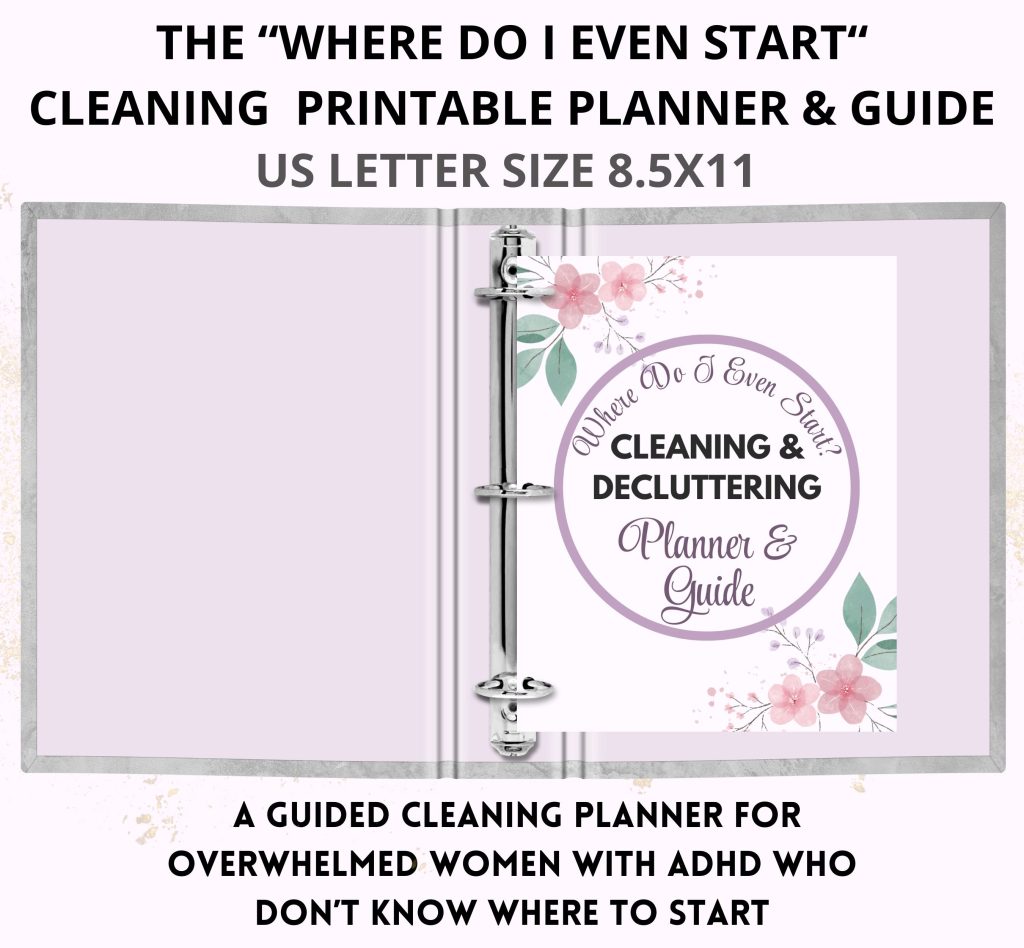
Overwhelmed by cleaning? This planner helps you start small so you can actually begin—no more wondering where to start, just one simple task at a time with no pressure to be perfect. Click here to see more!
Step 1: Take a Look at Your Real Week
Before you start filling in boxes on a cleaning chart, pause and think about what a typical week looks like for you.
Do you work long hours on Mondays? Are Tuesdays packed with after-school activities? Are you worn out by Thursday (I know I usually am)? These are the little details that make or break your cleaning routine.
If you don’t account for your actual energy levels and obligations, you’ll end up setting yourself up for burnout. But when you design your schedule around your life, instead of fighting against it, cleaning becomes easier, more predictable, and a whole lot less stressful.
Here’s what to do:
- Write out your week – Grab a piece of paper or open a note on your phone. List your typical week from Monday through Sunday. Include things like work hours, appointments, errands, and family commitments.
- Notice your energy patterns – When do you usually have more energy? Morning or night? Early in the week or later? Mark those times as your “higher energy” windows.
- Identify your low-energy days – Maybe Wednesday evenings or Sunday afternoons are your crash times. I know I’m pretty tired on Fridays so that’s a low-energy day for me. We’ll build in a low-effort cleaning version for those days.
- Look for small open spaces – You don’t need hours of time to make a difference. If you only have 15 minutes to clean, then schedule a task in that time frame every week.Thinking like this instead of in an all-or-nothing mentality is where you will really start to see progress.
When you can see your week laid out like this, you’ll have a clear idea of what’s realistic. The goal isn’t to cram cleaning into every available minute . Instead we want to find a way to work cleaning into your normal schedule so it doesn’t take over your life.
Because once your schedule matches your energy, you’ll stop fighting yourself. And that’s when everything starts to click.
Step 2: Create Your “High-Energy” Cleaning Schedule
Okay, now that you know what your week really looks like, it’s time to make the version of your cleaning schedule that’s for your high energy days.
You know those days when your coffee actually works, the brain fog has lifted, and you’re actually motivated to get things done? Man I love those days but they can be so rare…but I digress. When you feel amazing like this, you’ll pull out this high-energy cleaning plan.
Here’s how to build a high energy cleaning schedule:
a. Find a list of the most common household chores
The first thing you need to consider is what actually needs to be cleaned and when. Don’t create this list from scratch. There’s a checklist of household chores in my cleaning planner as well as some free ones that you can use. Cross off anything you don’t need done at your house. For instance, if a task on the list is to clean the garage and you don’t have a garage, cross that item off.
b. Decide how often you need to do each chore
For instance, some chores need to be done daily, weekly, and monthly. And then some cleaning tasks only need to be done seasonally (yay!).
How often a chore needs to be done will vary by household. An example of a chore that needs to be done daily in my house are dishes. And a chore that only needs to be done once a week for me is vacuuming but in your house you might need to do it daily.
You get to assess your own home and decide what does and doesn’t and how often.
c. Pick your cleaning tasks for each day.
Once you’ve decided which chores need to be done and how often, you need to decided which days to do them. Don’t try to clean your whole house at once unless you just really want to (I have those days too)!
Choose one or two main chores per day. For example:
- Monday: Laundry + clean the kitchen
- Tuesday: Bathrooms + empty trash
- Wednesday: Living room + vacuum floors
- Thursday: Bedrooms + change sheets
- Friday: Declutter one high traffic area (like the entryway or dining table)
- Saturday: Deep clean project (like organizing a closet or wiping down baseboards)
- Sunday: Rest + reset (light tidy-up, nothing major)
d. Stack tasks together.
If you’re already doing laundry, that’s a great time to clean the laundry room, wipe down the washer, or organize your cleaning supplies while you wait for the cycle to finish.
My laundry room is also where my main pantry is and I often have bags of non perishable groceries that I’ve so lovingly thrown in there. So when I do laundry, I will also put my groceries away as well.
So if you have two major but different tasks that are in the same room, you would put them on your schedule like “ laundry + grocery restock”.

How To Make Cleaning More Fun
Make cleaning feel good, not just a chore. Put on a fun playlist, listen to a podcast, or set a 20-minute timer so it feels like a quick challenge instead of an endless chore.
You could create a cleaning playlist on YouTube of songs that energize and motivate you to work! And I’m crazy so I actually march in place while I clean so I can get extra steps in. I’ll play one of the walk at home videos on YouTube and walk and clean!
Walking is great for weight loss and it helped me lose 50 pounds so I’m always looking for ways to sneak in extra movement LINK!!!
Example Of A High-Energy Cleaning Schedule
| Day | Focus Areas | Bonus Task |
| Monday | Laundry + Kitchen | Wipe counters and appliances |
| Tuesday | Bathroom | Wash towels + replace hand soap |
| Wednesday | Living Room | Vacuum couches + dust shelves |
| Thursday | Bedrooms | Change sheets + declutter nightstands |
| Friday | Catch-All Zone | Organize mail or paperwork |
| Saturday | Deep Clean Project | Clean windows or mop floors |
| Sunday | Rest + Reset | Quick tidy of main spaces |
When you have the energy, this schedule gives you structure to know where to start and stop. You’ll know exactly where to start, and that’s half the battle.
Plus, you’ll see a light at the end of the tunnel which will make cleaning less like a never ending task.
Step 3: Create Your “Low-Energy” Cleaning Schedule
Now let’s be honest — some days, your body (or brain) just says, “Nope, not today.”
And that’s okay. You don’t need to give up on having a peaceful home just because your energy is MIA. You just need a “low-energy” version of your cleaning plan.
This is your no frills go-to plan to use when you’re tired, hormonal, stressed, or just mentally tapped out.
It’s about maintaining your space so your house doesnt get out of control.
1. Focus on the “bare minimums.”
Ask yourself: “What are the smallest tasks I can do that’ll make the biggest difference?”
Think visual resets — the things that make your space look and feel cleaner with minimal effort.
For example:
- Make the bed (instant room upgrade).
- Toss clutter into a pretty basket or bin (bonus points if it has a lid).
- Wipe bathroom counters and mirrors with a disinfectant wipe.
- Load or start the dishwasher.
- Take out the trash.
- Start one load of laundry (you can fold it later… I’ve left laundry in the dryer for a week or longer and the world didn’t end)
Even doing just one or two of these keeps your home from slipping into total chaos while giving you that little sense of accomplishment your brain craves.
2. Have a “10-minute tidy” plan.
Set a timer for 10 or 15 minutes and focus on one area. I would choose a high traffic area like the kitchen or living room.
When the timer goes off, you’re done. You’ll be amazed at how much better the space looks, and sometimes that tiny start gives you a bit of momentum to keep going.
3. Keep a “lazy-day basket” handy.
This is your secret weapon for those days when you’re running on fumes.
Keep one decorative basket in each main room. When your brain can’t deal with sorting or organizing, just toss random clutter in there. Later (when you’re recharged), you can sort it properly. But for now? Don’t worry about it! The house looks cleaner and sometimes that’s all that matters.
4. Use your senses to boost energy.
If you can barely function, open a window, turn on upbeat music, or light a candle. Sometimes the smallest things can motivate you to clean. And if not, at least the candle will smell good.
Example of a Low-Energy Cleaning Schedule:
| Day | Focus Area | Minimum Task |
| Monday | Kitchen | Load dishwasher + wipe counters |
| Tuesday | Bathroom | Wipe sink + mirror |
| Wednesday | Living Room | Toss clutter in a bin |
| Thursday | Bedrooms | Make bed + pick up clothes |
| Friday | Catch-All Zone | Throw away obvious trash |
| Saturday | Optional Reset | Fold laundry or sweep floors |
| Sunday | Rest + Restore | Light tidy or nothing at all — just rest |
This version keeps your home manageable, even on your toughest days.
This low energy routine helps you create a home that feels calm enough for you to think, breathe, and rest.
Step 4: Understand the Mental Health Benefits of a Clean Space
Let’s be real…cleaning isn’t just about sparkling counters and fresh laundry. It’s about how your space makes you feel.
When your environment is messy, your brain can feel messy too. At least that’s how it is for me. A dirty house can put me in such a bad mood. You might feel scattered, anxious, or like you can’t relax because everywhere you look, there’s something screaming for your attention. But when your space is tidy, even just one room, it gives your mind permission to breathe.
A clean and organized home can:
- 🧘🏾♀️ Reduce anxiety and stress. There’s less visual clutter competing for your attention, which helps your brain focus and rest.
- 🌞 Boost your mood and energy. Natural light hits differently when it’s not bouncing off piles of laundry. You’ll actually want to be in your space.
- 💭 Help with mental clarity. When things are put away, you’re not constantly trying to remember what’s where or what you forgot to do.
- 😌 Make you feel more in control. Life already throws enough chaos your way and your home doesn’t need to add to it. Even small wins like wiping down the counter or clearing one surface can remind you, can give you a sense of pride.”
- ❤️ Support self-worth and peace. Taking care of your environment is a form of self-care. It’s saying, “I deserve to live in a space that feels good.”
Transparency Time: This Is Not How I Clean
Let me be very transparent here. I don’t clean on a schedule. About the only schedule I have is doing laundry on Saturday. Everything else? I clean on an as needed basis. I do this for many reasons. I don’t mind cleaning…that’s number one.
Not only do I not mind but I actually like cleaning. Number two, I don’t like the idea of only part of my house being clean but the other parts looking like a tornado hit it. So I basically clean the whole house or tidy it every day so that it rarely gets just completely out of control.
Yes, I do have days where it’s my version of a pig stye but even then, I can make the house “company” ready in an hour or maybe a little more.
However, I write posts like this because not everyone has the time or the energy to clean every day. so I do truly hope that these cleaning schedule tips will be helpful to those who may need it.
And there’s no shame in needing it. I just wanted to be honest and say I don’t personally use a schedule. Plus, I suck at using schedules anyway.
Your Cleaning Schedule, Your Rules
Here’s the truth: there’s no one-size-fits-all cleaning routine, especially if your energy levels change from day to day.
And that’s okay.
What matters most is creating a schedule that fits your real life, not the one you wish you had. Some days you’ll feel like a whole cleaning queen, blasting music, mopping floors, and organizing closets like you’re on a home makeover show.
Other days, the most you’ll manage is tossing clutter into a cute basket and calling it a win.
Both count.
Because consistency doesn’t mean doing everything perfectly. It means showing up in some way no matter how small.
When you design a cleaning schedule around your energy, your routines, and your actual life, you stop fighting against yourself.
You start working with yourself.
And that’s how real, lasting habits are built — with grace, flexibility, and a little bit of rhythm.
So don’t aim for perfect.
Aim for peaceful.
Now grab your notebook (or your favorite notes app) and map out your two versions of a cleaning schedule — one for high-energy days and one for low-energy ones.
Before you know it, your home will feel lighter, calmer, and way more manageable… even if it’s not “Pinterest perfect.”
